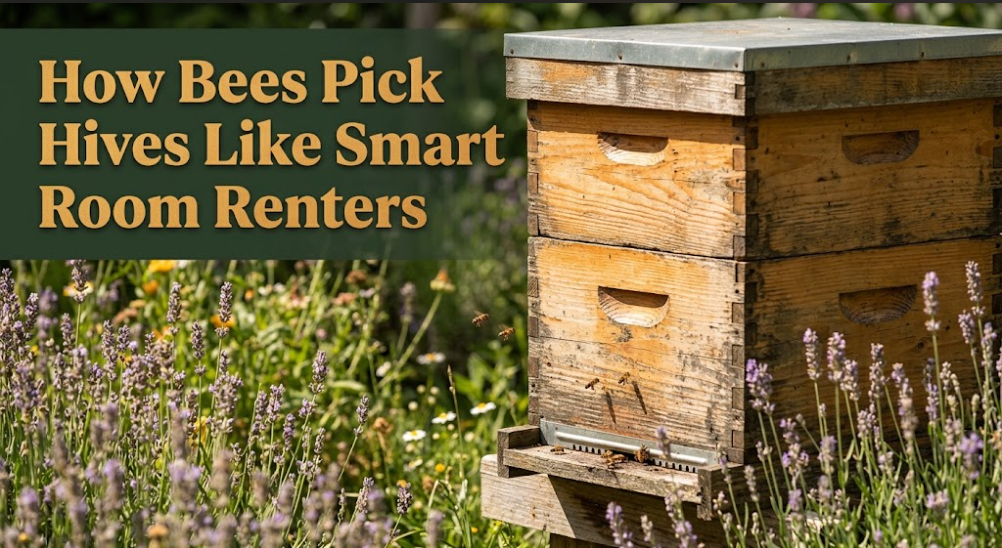
A honeybee swarm will sometimes take three days to pick a new home. Not because they’re indecisive, but because they’re running something close to a formal evaluation process, with scouts checking multiple sites, reporting back, and building consensus before anyone commits. I came across this while reading about swarm behavior for an unrelated reason, and it stopped me cold. It’s a better vetting process than most people use when renting a room.
1. What the Scouts Actually Check
Researchers who study swarm behavior, most notably Thomas Seeley at Cornell, found that scout bees evaluate potential hive sites against a fairly consistent checklist: cavity volume, entrance size, entrance height off the ground, and how well the space can be defended. A cavity that’s too small gets rejected even if it’s otherwise appealing. One with too large an entrance gets marked down because it’s harder to guard against intruders.
What’s notable is that no single scout makes the call. Multiple scouts visit the same site independently, and only when enough of them return with the same enthusiasm, communicated through a waggle dance, does the swarm start converging on a decision. One bee liking a spot means nothing. A pattern across several means something.
Renters do the opposite constantly. One good feeling from a single visit, one friendly landlord, one nice photo, and the decision is basically made before anything gets cross-checked. If you’ve read our piece on <a href=”https://rentbyroomguide.online/tested-safe-room-rental-checks/”>tested safe room rental checks</a>, you already know that a single good impression is exactly the wrong basis for a decision this size.
2. The Bee Version of a Red Flag
Bees reject cavities with entrances facing certain directions, entrances that are too exposed, and cavities near existing threats like ant colonies. They’re not being paranoid. They’re pattern-matching against outcomes that have historically gone badly for previous colonies, encoded over generations into instinct.
Renters don’t have generations of encoded instinct to fall back on, which is honestly the whole problem. Most people rent a handful of rooms in their lifetime, so the pattern recognition has to be built consciously instead of inherited. That’s most of what our piece on signs a room landlord is not legitimate is trying to hand people directly, since they can’t wait around to develop the instinct through repeated bad experiences.

And here’s where the comparison actually gets useful instead of just charming. Bees don’t rely on vibes. They rely on specific, checkable criteria, applied the same way every time, regardless of how tired the scout is or how long the swarm has already been searching. That consistency is the entire point.
3. Where the Comparison Holds and Where It Breaks
A room listing can’t be evaluated purely through structural criteria the way a tree cavity can, because a huge part of a room rental is about people, not just walls and entrances. A landlord who ghosts you for two days before move-in is a different kind of risk than an entrance facing the wrong direction. So the metaphor has limits.
But the underlying method transfers cleanly. Multiple independent checks, weighted criteria, and a refusal to commit based on one good impression, that part works for renters exactly as well as it works for bees.
| Bee Criteria | Renter Equivalent |
|---|---|
| Cavity volume checked by multiple scouts | Room size confirmed through photos, video call, and in person |
| Entrance defensibility | Lock quality, building security, who else has access |
| Distance from known threats | Neighborhood safety, landlord’s other properties or complaints |
| Consensus across scouts before committing | Multiple independent signals, not one good conversation |
| Rejection of sites that fail even one hard criterion | Walking away from listings that fail on deposit terms or verification, regardless of price |
4. The One-Bee Problem
Here’s where people usually go wrong, and it’s almost always the same mistake. A renter meets one landlord, has one good conversation, and treats that single data point as sufficient. It’s the equivalent of a swarm committing to a hive because one scout liked it, without waiting for a second or third opinion.
Rent By Room Guide sees this constantly in reader questions. Someone writes in convinced a room is fine because the landlord “seemed really nice,” with no mention of anything else they actually checked. Nice is not a criterion. It’s not even weak evidence, honestly, because plenty of people running scams are perfectly pleasant on a first call.
What actually works is closer to the swarm model: check the listing against our guide on <a href=”https://rentbyroomguide.online/how-to-verify-a-room-listing-is-real/”>how to verify a room listing is real</a>, do a video walkthrough, ask a second person you trust to look at the listing with fresh eyes, and only move forward once several of those checks agree, not just one.
5. Why Consensus Beats a Gut Feeling
Swarms that skip the consensus-building process and settle too fast pick worse hives on average, ones that are more exposed to weather or predators. The three-day deliberation isn’t inefficiency. It’s the mechanism that produces better outcomes.

Renters under time pressure, needing a room in a week because a lease is ending, skip their own version of this process constantly. And I get why. Waiting feels risky when the clock is running. But a rushed decision on a room you’ll live in for a year carries more downside than an extra two or three days of checking.
If timing pressure is part of what’s driving the rush, our breakdown of <a href=”https://rentbyroomguide.online/what-to-ask-before-moving-in-with-roommates/”>what to ask before moving in with roommates</a> is worth going through even under a deadline, because it takes fifteen minutes and catches most of what a rushed decision misses.
A Simple Version to Actually Use
At-a-glance version of the swarm method for room hunting:
- Check the listing itself, does it hold up under a video call, not just photos
- Check the landlord, do their answers stay consistent across two separate conversations
- Check a second person’s opinion, someone not emotionally invested in you finding a room today
- Check the deposit terms against what’s normal for the area
- Only move forward once three or more of these line up, not just one
None of this needs to take three days. But it needs more than one good phone call.
Frequently Asked Questions
Is this bee comparison actually based on real research, or just a metaphor? It’s based on real research, primarily Thomas Seeley’s work on honeybee swarm decision-making at Cornell. The specific criteria bees use, cavity size, entrance height, defensibility, are documented findings, not an invented analogy.
How many “checks” should a renter realistically do before committing? Three independent signals is a reasonable minimum: a video walkthrough or in-person visit, a second conversation with the landlord on a different day, and a second person’s read on the listing. More is better if time allows.
What if I only have one day to decide because the room will get taken? Compress the checks rather than skipping them. A same-day video call plus a quick second opinion from a friend still covers most of what matters, even without three full days.
Does this apply to renting from a property management company too, or just individual landlords? It applies to both, though management companies usually have more paperwork consistency, which serves as one of your checks automatically. Individual landlords require more manual verification since there’s less of a paper trail.
What’s the biggest single mistake renters make compared to how bees vet a site? Committing after one positive signal instead of waiting for a pattern across several. Bees won’t move the swarm until enough scouts agree, and renters would avoid a lot of bad rooms by holding themselves to the same standard.
For more on building a repeatable checklist before you commit to any room, Rent By Room Guide Online has additional breakdowns at rentbyroomguide.online.