A woman in Ohio wired a $600 deposit to a “landlord” she’d never met, for a room she’d never seen, because the listing photos looked exactly like every other clean, sunlit rental on the site. Three days later the real tenant, who still lived there, called to ask why strangers kept showing up asking for keys. The listing had been copied from a legitimate rental, reposted with a fake name attached, and the deposit was gone before anyone realized what happened.
Room rentals are an especially easy target for this kind of scam. There’s no lease review by a bank, no title search, often no in-person walkthrough before money changes hands. At Rent By Room Guide Online, we hear versions of this story more often than we’d like. The good news is that illegitimate landlords tend to make the same mistakes over and over, and once you know what they are, they’re not hard to spot.
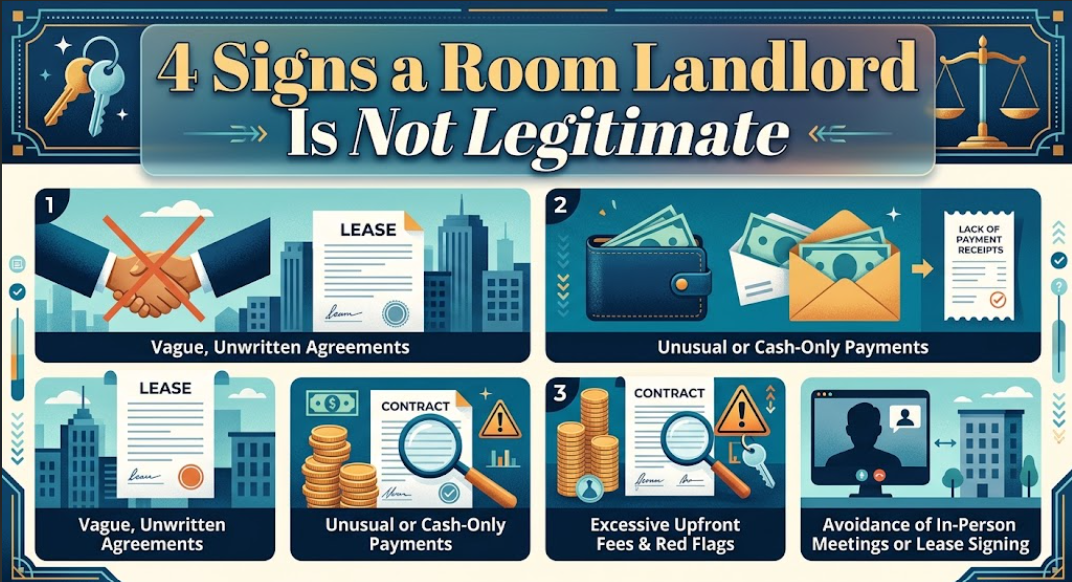
1. They Push You to Pay Before You’ve Seen the Room
This is the single biggest tell. A legitimate landlord, or the property manager working for one, wants to rent to someone who has actually walked through the space and confirmed they want to live there. Scammers want the opposite. They want your money committed before you’ve had a chance to notice anything wrong, because once you’ve seen the room in person, the scam usually falls apart.
Watch for any combination of these:
- The landlord is “traveling” or “out of the country” and can’t show the unit themselves
- They ask you to send a deposit or first month’s rent to “hold” the room before a viewing
- They claim there’s another interested renter and create urgency around a fast decision
- Payment is requested via wire transfer, gift cards, or a payment app with no buyer protection
If you read how to negotiate a lower room rent, you’ll notice that real negotiation only happens after both sides have actually seen what they’re negotiating over. A landlord who skips that step entirely isn’t in a hurry. They’re avoiding scrutiny.
There’s a version of this that’s more subtle and catches smart people too: the landlord agrees to a showing, but only virtually, over video call, and the video conveniently cuts out or freezes right as you’re about to see something specific, like the shared bathroom or the actual street the building sits on. That’s not paranoia talking. That’s a pattern.
2. The Listing Details Don’t Match Anywhere Else
Copy the listing photos and run a reverse image search. This takes about thirty seconds and it is, without exaggeration, the single most effective thing you can do before contacting any landlord about a room you found online. Scammers frequently lift photos from legitimate listings on other sites, sometimes from the same platform, sometimes from a completely different one.
Here’s what a mismatch usually looks like in practice:
| What You See | What It Might Mean |
|---|---|
| Same photos posted under two different names | Listing was copied and reposted |
| Address doesn’t match the photos on Google Street View | Photos aren’t of the actual property |
| Price is significantly below comparable rooms nearby | Bait to generate contact quickly |
| Listing was posted minutes or hours ago with a fully written bio | Template used across many fake posts |
| Landlord’s contact info is a number with no local area code and no verifiable name | Harder to trace, easier to disappear |
If you’ve spent any time comparing options, you already have a rough sense of what similar rooms in the area actually go for. That instinct is worth trusting. We wrote about this exact gap in why room rent varies so much by area, and one of the patterns that comes up again and again is that legitimate landlords price within a fairly predictable range for their neighborhood and room type. A price that’s dramatically lower than everything around it isn’t a lucky find. It’s designed to make you move fast before you compare it to anything else.
3. They Can’t or Won’t Prove They Own or Manage the Property
Ask a legitimate landlord how to verify their ownership or management authority and they’ll usually have an answer ready, because they’ve been asked before and it doesn’t threaten them. A property manager can point you to the management company. An owner can show a tax bill, a mortgage statement, or a deed, with the sensitive numbers blacked out. None of that is an unreasonable ask, and none of it should offend anyone who’s actually renting out their own property.
This is where people usually go wrong: they assume that pushing for proof of ownership is rude, or that it’ll make them look distrustful and cost them the room. In practice, the opposite tends to be true. Landlords who are legitimate are used to this question. Landlords who aren’t will often get defensive, change the subject, or suddenly become very busy.
A few ways to check ownership without making it awkward:
- Ask for the property address and look it up in your county’s public property records, which are usually searchable online for free
- Ask who manages the building day to day, and whether there’s a number for that management office separate from the “landlord’s” personal cell
- If it’s a house being rented room by room, ask how long they’ve owned it. Vague or shifting answers are worth noting
We go into this in more detail in roommate red flags you should never ignore, and honestly a lot of the same logic applies to the person collecting your rent as applies to the people you’ll be living with. If something about how they explain their own situation keeps shifting between conversations, that inconsistency is data. Pay attention to it.
4. The Lease, If There Is One, Is Vague, Rushed, or Doesn’t Exist
A written lease protects both sides. A landlord with nothing to hide generally wants the terms in writing too, because it protects their deposit, their property, and their ability to enforce house rules. So when a “landlord” is reluctant to put anything on paper, or hands over a lease that’s a single vague paragraph with no specifics, that’s not a minor inconvenience. It’s a signal.

What a real room rental lease should include, at minimum:
- Full names of everyone party to the agreement, including the landlord
- Monthly rent amount, due date, and accepted payment methods
- Deposit amount and the specific conditions under which it’s refundable
- What’s included, like utilities, wifi, or furnishings, and what’s separate
- Move-in date and length of the agreement
If someone’s rushing you past these details, or telling you it’s “just a formality” and you can sign later after you’ve already paid, slow down. And if there’s genuinely no lease at all, that’s a decision you can make with your eyes open, but it shouldn’t be a surprise you discover after the money’s already sent. We put together how to write a simple roommate agreement for situations like this, and even an informal version of that document is better than a verbal promise from someone you met three days ago on the internet.
One more thing worth saying plainly: legitimate landlords make mistakes too. Some are disorganized, slow to respond, or bad at explaining terms clearly without actually being dishonest. The difference isn’t perfection. It’s whether the gaps get filled in when you ask, or whether they get bigger.
If two or three of these signs show up together, that’s the point to stop and walk away, not the point to ask one more clarifying question and hope it resolves itself.
FAQs
Can I lose money even if I never wired anything? Yes. Some scams collect an “application fee” or “background check fee” through a payment app, which is smaller and feels less risky, but works the same way. Any payment before you’ve verified the person and the property carries this risk.
Is it a red flag if the landlord wants to meet somewhere other than the property? Not automatically, especially for a first conversation in a public place. It becomes a concern if they keep avoiding letting you inside the actual unit before any money is exchanged.
What if the listing is on a well-known platform, does that mean it’s safe? No. Platform size doesn’t guarantee the individual listing is legitimate. Scammers post on major sites specifically because renters assume the platform has already screened them.
Should I still rent from someone who seems a little disorganized but not deceptive? That’s a judgment call, and disorganization on its own isn’t the same as dishonesty. Look at whether they answer direct questions clearly when asked, even if their communication style is casual or slow.
What’s the fastest single check I can do before contacting any landlord? Reverse image search the listing photos. It takes under a minute and catches a large share of copied or fake listings before you’ve invested any time or money.
For more on what to look for before you commit to a room, is a furnished room worth the extra cost is a good next read.