
A woman in Ohio wired $1,400 to a “landlord” who sent her twelve photos of a sunlit room, a signed lease template, and a friendly note about picking up keys on Saturday. There was no Saturday. There was no room. The listing had been lifted from a real rental three states away, and by the time she realized it, the wire was long gone and untraceable.
That story isn’t rare. It’s the most common version of a scam that shows up constantly in the room-rental world, and wiring money is almost always the mechanism that makes it work.
1. Why Wire Transfers Are the Scammer’s Favorite Tool
Wire transfers move fast and they move in one direction. Once the money lands, it’s essentially gone. There’s no chargeback, no dispute process, no bank stepping in to claw it back the way a credit card company might. A scammer who convinces you to wire funds knows the transaction is final the second it clears.
Compare that to how you’d typically pay in a legitimate room-sharing arrangement, and the difference in risk gets obvious fast.
| Payment Method | Reversible? | Common in Legit Deals? | Scam Risk |
|---|---|---|---|
| Wire transfer | No | Rarely | Very high |
| Cashier’s check to a stranger | Rare | Sometimes, wrongly | High |
| Cash in person, after viewing | No, but you saw the room | Yes | Low |
| Certified payment app with buyer protection | Sometimes | Yes | Moderate |
| Check to a verified landlord/property manager | Yes (before it clears) | Yes | Low |
Notice the pattern. The riskiest methods are the ones that skip the part where you actually see the room and meet a real person attached to a real address. That’s not a coincidence. Scammers specifically request wires because it removes every safety net a normal transaction would have.
2. What a Legitimate Room Deposit Actually Looks Like
If you’ve spent any time reading through what utilities come included in room rent, you already know that a real room-sharing arrangement involves paperwork, specifics, and usually a bit of back-and-forth. That friction is a feature, not a bug.

A legitimate deposit request tends to come with:
- A named individual you can find outside the listing itself (social media, mutual connections, a property management company with a real office)
- Willingness to let you view the room in person, or at minimum do a live video walkthrough where you can ask them to show you the building exterior and mailbox
- A written agreement, even a simple one, before any money changes hands
- No urgency pressure. Real landlords don’t usually panic if you want a day to think it over
And here’s where people usually go wrong: they assume urgency means the deal is competitive, when actually urgency is the scam’s core engine. “Someone else is looking at it tonight” is designed to short-circuit your instinct to slow down and check. A good room, in a normal market, can survive you taking 24 hours to verify who you’re paying.
3. Red Flags That Show Up Almost Every Time
I’ve seen the same handful of warning signs recur across nearly every fraudulent room listing that’s been reported to consumer protection agencies. None of them are subtle once you know to look.
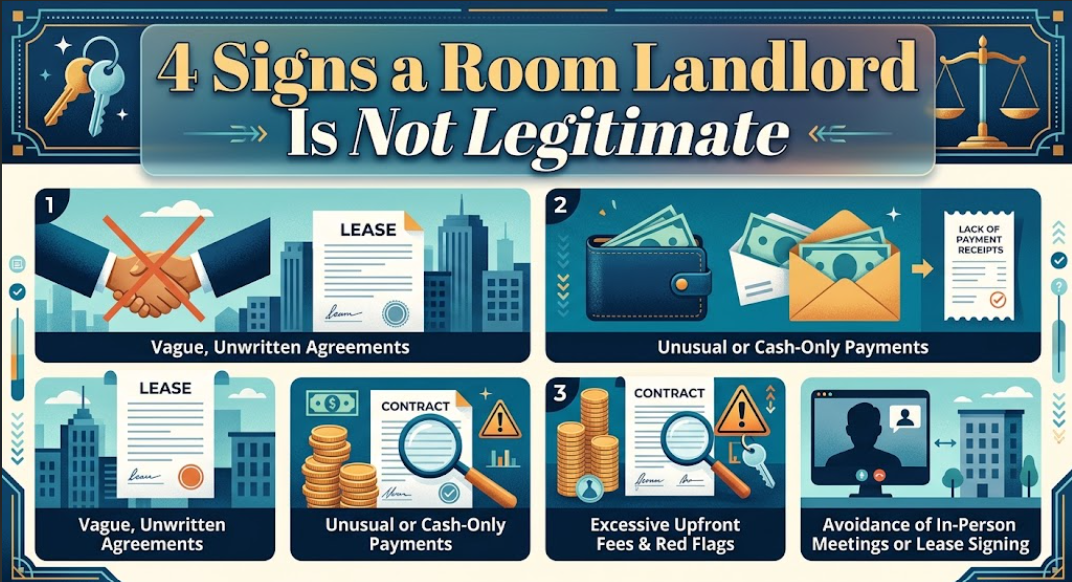
The landlord is “traveling” or “out of the country” and can’t show the room in person. This one alone should end the conversation. If you can’t physically enter the room before paying anything beyond a small application fee, you don’t have enough information to make a financial decision.
Photos look slightly too polished, or a reverse image search turns up the same photos on a different listing site under a different city. This happens constantly, and it takes about ninety seconds to check.
The listing price is noticeably below what similar rooms go for nearby. If you’re unsure what “normal” looks like in your area, it’s worth comparing against best cities for cheap room rentals in 2026 or checking regional pricing patterns before assuming a deal is just lucky.
They ask specifically for a wire, a prepaid gift card, or cryptocurrency, and get vague or irritated if you ask about alternatives.
4. What To Do Instead of Wiring Money
Ask to see the room. In person if at all possible, live video if distance genuinely prevents it, and during that video, ask them to walk to a window or door and show you something that confirms the address, like mail with a visible unit number.

Search the address. A quick search on the exact street address plus “rental scam” or “room for rent” surfaces a shocking number of duplicate listings and warning threads.
Verify the person exists outside the platform. A LinkedIn profile, a business registration, a property management website with a working phone number. Scammers rarely bother building out a convincing secondary presence because it’s more work than the payoff usually justifies.
Use a payment method that leaves a paper trail and offers some recourse, and hold off on paying anything substantial until after you’ve signed something in writing. If the person resists a written agreement, that resistance is the answer.
If you’re moving in with roommates rather than renting from a landlord directly, it’s also worth reading through roommate red flags you should never ignore before any money moves, since a lot of the same instincts apply even when the other party isn’t a stranger running a scam, just someone who isn’t being upfront about the arrangement.
5. A Quick Gut-Check Before You Send Anything
Here’s a simple checklist worth running through before any deposit leaves your account:
- Have I seen the actual room, in person or via live video?
- Can I find this person or company outside the listing itself?
- Is there a written agreement, even a basic one?
- Am I being pressured to act faster than feels comfortable?
- Is the payment method reversible in any way?
If two or more of those don’t check out, stop. Not “proceed cautiously.” Stop.
And to be fair, sometimes the room is real, the landlord is real, and they’re just old-fashioned and genuinely prefer wires because that’s how they’ve always done business. It happens. But you don’t find that out by wiring the money first and hoping. You find it out by asking for the viewing first and letting their answer tell you what you need to know. Most legitimate landlords won’t blink at the request. The ones who do are telling you something, even if they don’t mean to.
Budgeting for the deposit itself is its own separate question, and if you haven’t worked out what’s reasonable to set aside, how much should you budget for a room is a good place to start before you’re in a position where you’re being rushed into a decision you haven’t budgeted for anyway.
FAQs
Is it ever okay to wire a security deposit? Generally, no, unless you’ve already verified the room, the landlord, and the paperwork through other means first. Even then, a payment method with some reversibility is safer.
What if the landlord says wiring is the only option they accept? That alone isn’t automatically a scam, but combined with an inability to view the room in person, it’s a strong enough signal to walk away.
I already wired money and think I was scammed. What now? Contact your bank immediately, even though wires are hard to reverse, because speed sometimes matters. File a report with the FTC and your local police, and report the listing to whatever platform it appeared on.
How much should a room deposit typically be? It varies by city and market, usually somewhere between one half and one full month’s rent, though this differs enough by region that it’s worth checking local norms rather than assuming a flat number.
Are roommate situations safer than renting from a stranger landlord? Not automatically. Scams happen in both setups, though roommate arrangements at least usually involve meeting someone face to face first, which removes one layer of risk.
For more on spotting problems before they cost you money, Rent By Room Guide Online has a broader guide on 5 signs a cheap room rental is overpriced worth reading before your next search.